Shadow boxing is a practical way to learn boxing fundamentals without a partner, heavy bag, or specialized equipment. It combines punches, footwork, and defensive movements against an imaginary opponent. Although the movements may look simple, performing them well requires coordination, balance, and an understanding of how the hands and feet work together.
Boxers use shadow boxing to warm up, sharpen technique, rehearse combinations, and prepare for sparring. Beginners can develop the same fundamental skills while improving cardiovascular fitness. With no bag or opponent restricting movement, there is room to practice changing angles, adjusting distance, and moving between offense and defense.
The best results come from giving each round a clear purpose. Rather than throwing punches at random, focus on specific movements and gradually combine them as your coordination improves.
What Is Shadow Boxing?
Shadow boxing is a training method that involves throwing punches, practicing defensive reactions, and moving around an imaginary opponent without making physical contact. Instead of responding to a real target, the boxer visualizes an opponent’s position and adjusts their movements accordingly. A typical round includes jabs, crosses, hooks, uppercuts, slips, pivots, and changes of direction. Some rounds focus on slow, deliberate movements, while others use quicker combinations and footwork to simulate the pace of a boxing exchange. Training without a target has its advantages.
When a punch meets no resistance, the boxer must control its extension and recovery. The hips and shoulders should rotate without pulling the body off balance, and the punching hand should return directly to its defensive position. Shadow boxing also introduces tactical thinking. An imagined opponent might advance behind a jab, retreat after an exchange, or attempt a counterpunch. Responding to these situations encourages decisions about distance, timing, and positioning rather than simply repeating memorized combinations. Beginners are better off mastering a few controlled movements before attempting the speed and complexity of experienced fighters.
Benefits of Shadow Boxing for Fitness and Boxing Skills
Shadow boxing develops physical qualities that support boxing performance while providing an accessible workout for general fitness. Because there is no impact against a bag or opponent, beginners can concentrate on movement mechanics without the demands of contact training. Regular practice can help improve:
- Cardiovascular endurance. Continuous punching and footwork increase heart rate, particularly during sustained rounds with short rest periods.
- Coordination. Combining punches with steps, pivots, and defensive reactions trains the upper and lower body to move together.
- Balance and body control. Changing direction while maintaining a stable stance improves weight distribution and movement efficiency.
- Technical consistency. Repeated practice helps reinforce punching mechanics, defensive positioning, and smooth transitions between combinations.
- Movement awareness. Working against an imagined opponent encourages attention to distance, angles, and positioning.
- Muscular endurance. Sustained punching and movement challenge the shoulders, legs, and trunk, although they provide limited resistance for developing maximal strength.
Training intensity is easy to adjust. A beginner might work through two-minute rounds at a relaxed pace, while an experienced boxer can use longer rounds with more complex combinations and frequent changes of direction. There are limitations. Without a real opponent, shadow boxing cannot fully teach accurate distance judgment, reactions to unpredictable punches, or the experience of working under pressure. Heavy bag training, focus mitt drills, partner exercises, and supervised sparring offer feedback you cannot get from solo practice. For general fitness, shadow boxing remains a convenient option that requires little space and no expensive equipment.
How to Shadow Box With Proper Technique
Learning how to shadow box starts with a stable stance, coordinated footwork, and controlled punching mechanics. Beginners often move their hands faster than their feet can support, leaving them poorly positioned after a combination. Choose an open area with enough space to move in several directions. Wear comfortable athletic clothing and shoes that allow smooth, controlled pivots. A mirror can help identify posture problems, although constantly watching your reflection may interfere with natural movement. Begin with relaxed steps and basic punches. Keep your knees slightly bent, your chin tucked, and your hands near your face. Exhale briefly as you punch rather than holding your breath. Every combination should leave you ready to defend, counter, or change position.
Boxing Stance, Footwork and Movement
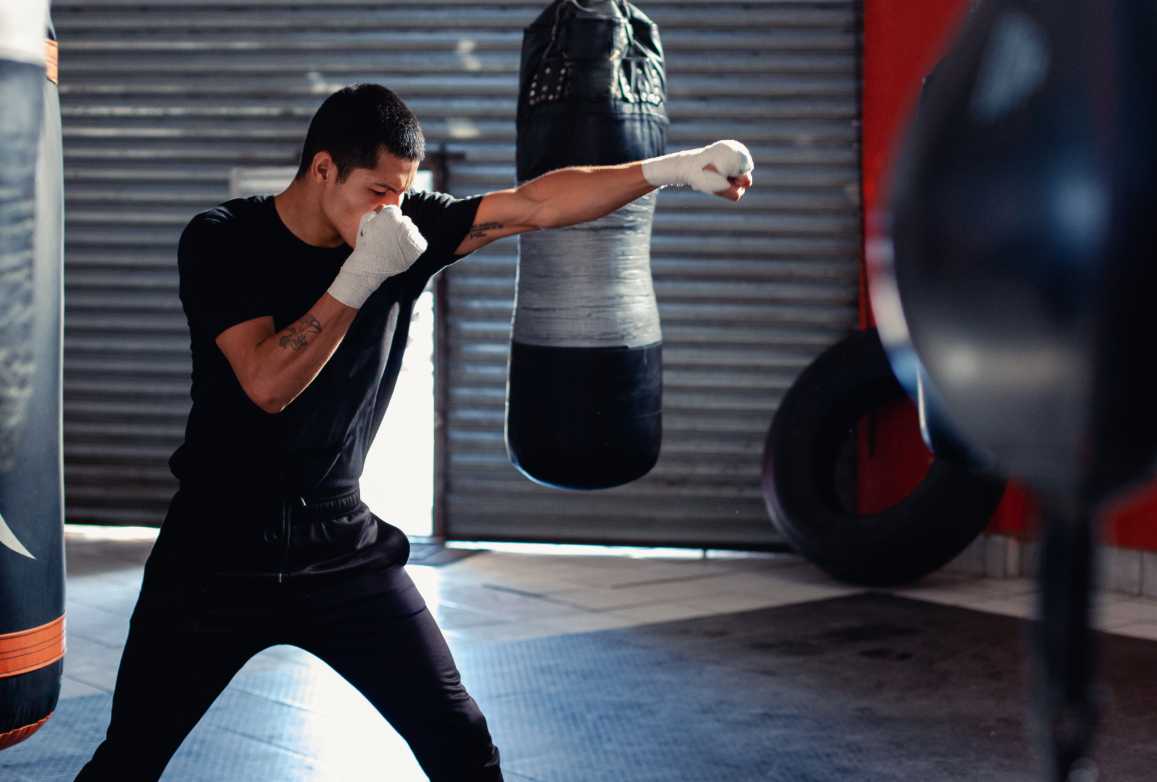
In an orthodox stance, the left foot is forward and the right foot is behind. A southpaw stance reverses this arrangement. Keep your feet approximately shoulder-width apart, with enough distance between the front and rear foot to maintain stability. Distribute your weight comfortably between both legs. The rear heel may be slightly raised to make rotation and movement easier. Avoid placing your feet on the same narrow line, which reduces lateral stability and makes it harder to change direction. Keep your hands near your face, your elbows positioned to protect the body, and your shoulders relaxed. Basic boxing footwork follows a simple rule: move the foot closest to your intended direction first, then bring the other foot along to restore your stance. In an orthodox stance, moving forward begins with the left foot, followed by the right. When retreating, the right foot moves first. The same principle applies to sideways movement.
Use short, controlled steps. Excessively wide steps make it harder to stay balanced between movements, while bringing your feet too close together makes it difficult to punch or defend. Avoid crossing your feet during basic movement drills. Once forward, backward, and lateral steps feel natural, introduce pivots. A pivot changes your facing angle by rotating around one foot while the other adjusts. It allows you to reposition without taking several large steps. For a simple drill, take two short steps forward, retreat twice, then pivot and reset your stance. Keep your upper body balanced throughout.
Punch Combinations and Defensive Movements
The jab and cross form the foundation of beginner boxing combinations. The jab starts with the lead hand and travels directly toward the target. Extend the arm while allowing the lead shoulder to move forward naturally. Keep the rear hand close to your face and bring the jab straight back to its starting position. The cross is thrown with the rear hand and uses greater rotation through the hips and shoulders. As the body turns, the rear foot can rotate naturally to support the punch. Avoid reaching forward with the upper body or allowing your weight to carry you beyond your stance. Once straight punches feel comfortable, introduce hooks and uppercuts. A hook follows a curved path, with the hips and torso helping generate the movement. Avoid swinging the arm widely. An uppercut travels upward with the elbow bent, using coordinated movement through the legs, hips, and torso rather than lifting the arm alone.
Without a physical target to absorb the impact, punches should finish under control. Do not forcefully snap the elbow into a locked position, particularly when practicing faster combinations. Punch numbering varies between gyms, but the following system is commonly used:
| Number | Punch |
| 1 | Lead jab |
| 2 | Rear cross |
| 3 | Lead hook |
| 4 | Rear hook |
| 5 | Lead uppercut |
| 6 | Rear uppercut |
Start with a jab-cross combination (1-2). After both punches, recover your stance and take a small step to adjust your position. The jab-cross-lead hook (1-2-3) introduces an additional punching angle and requires coordinated rotation. A jab-cross-slip sequence adds a defensive reaction after the attack. To slip a straight punch, move your head just outside its imagined path using a small rotation of the torso and a slight bend in the knees. Keep your weight balanced over your feet rather than leaning excessively to one side. To roll under an imagined hook, bend your knees and guide your head through a compact U-shaped path before rising into a balanced stance. Avoid folding forward at the waist or looking down at the floor.
Defensive movements become more useful when connected to counterattacks. For example, imagine slipping outside an opponent’s jab, answering with a cross, and pivoting away from the line of attack.
Shadow Boxing Workout for Beginners
A beginner shadow boxing workout should combine basic technique, manageable round lengths, and enough recovery to prevent fatigue from disrupting movement. Three two-minute rounds provide six minutes of active practice, making them a reasonable starting point for someone learning boxing fundamentals. Begin with three to five minutes of light activity. March or jog in place, perform shoulder circles and gentle trunk rotations, then move through a few relaxed boxing steps. Use the following three-round workout:
| Round | Focus | Instructions |
| 1 | Stance and footwork | Move forward, backward, and sideways. Add occasional jabs while maintaining a stable stance. |
| 2 | Basic combinations | Alternate jab-cross and jab-cross-hook combinations. Focus on coordinated rotation and controlled recovery. |
| 3 | Offense and defense | Throw short combinations, then add slips, rolls, or pivots before changing position. |
Perform each round for two minutes, resting for 45 to 60 seconds between rounds. Keep the intensity moderate enough to maintain proper technique. If your breathing becomes too heavy or your movements start to lose coordination, slow down. As your conditioning improves, extend the rounds to three minutes or add a fourth round. Increase one element at a time rather than making the workout longer and faster simultaneously. More confident beginners can introduce brief bursts of quicker combinations followed by slower movement. During these intervals, speed should come from coordinated technique rather than uncontrolled arm movement. Finish with a few minutes of easy walking and relaxed movement as your breathing returns toward normal.
Shadow Boxing Drills to Improve Speed and Coordination
Different shadow boxing exercises can isolate specific skills before they are combined in longer rounds. Footwork drills develop positioning, while combination and defensive drills help coordinate movement at changing speeds.
- Jab and Step Drill
Step forward with a jab, then move back into your starting stance. Coordinate the punch with the lead-foot step rather than reaching forward with your upper body. Once the timing feels natural, practice jabbing while retreating or moving laterally. Keep your feet properly spaced and avoid leaning away from your stance. Practice for 30 to 60 seconds before changing direction.
- Combination and Exit Drill
Throw a jab-cross-hook combination, then immediately step or pivot away from the imaginary opponent. The objective is to finish the attack without remaining directly in front of the opponent. Practice exiting to either side while keeping your stance organized and your hands ready to defend. Pause briefly between repetitions if your footwork starts to break down.
- Slip and Counter Drill
Imagine a straight punch approaching your head. Move just outside its path with a compact slip, then answer with a controlled counterpunch. Alternate between slipping left and right. Keep your eyes forward and avoid moving your head so far that you cannot return to a balanced position. Begin slowly, concentrating on the transition from defense to attack.
- Tempo Change Drill
Alternate 20 seconds of relaxed combinations with 10 seconds of quicker punching. Continue for one or two minutes. During the faster intervals, use short combinations that you can perform cleanly. Reduce the number of punches if your stance or coordination begins to deteriorate. The aim is to change rhythm without sacrificing control.
- Angle and Pivot Drill
Imagine an opponent standing directly ahead. Throw a jab-cross combination, then pivot to create a new punching angle. After turning, restore your stance and face the imaginary opponent from the new position. Practice pivots in both directions, paying attention to where your feet finish. This drill teaches you to reposition for another attack rather than simply retreating after punching.
- Technical Visualization Drill
Picture an opponent with a specific fighting pattern. They might advance behind repeated jabs, retreat after each exchange, or wait for an opportunity to counter. Against an advancing opponent, practice using the jab while moving backward, then pivot to avoid retreating in a straight line. Against someone who keeps backing away, work on closing distance with measured steps while maintaining your stance. Visualization cannot reproduce the timing or unpredictability of a live opponent, but it gives solo training a tactical purpose. Beginners can choose two or three drills per session. Short, focused sessions make it easier to recognize technical mistakes than attempting every exercise at once.
Common Shadow Boxing Mistakes to Avoid
Shadow boxing allows considerable freedom of movement, but practicing without immediate feedback can also reinforce poor habits. One common mistake is throwing every punch at maximum speed or power. Because there is no target to absorb the force, aggressive extension can place unnecessary stress on the shoulders and elbows. Practice controlled acceleration rather than trying to generate maximum force. Another problem is remaining stationary through long combinations. In boxing, distance and positioning change throughout an exchange. Even basic shadow boxing should include small steps, adjustments, and occasional changes of angle. Other mistakes include:
- Dropping the hands after punching. Bring each hand back to its defensive position instead of allowing it to fall toward the waist.
- Overreaching. Avoid leaning forward to reach an imaginary target. Adjust the distance with your feet.
- Taking excessively wide steps. Large movements can disrupt weight distribution and make it difficult to punch or change direction.
- Exaggerating defensive movements. Deep slips and unnecessarily wide rolls can leave you exposed or slow your recovery.
- Holding your breath. Exhale briefly during punches and maintain a natural breathing rhythm between exchanges.
- Repeating combinations mechanically. Change the distance, direction, or defensive response rather than performing identical sequences without context.
- Training without a clear objective. Assign each round a specific focus, such as footwork, counterpunching, or maintaining a stable stance.
A mirror can reveal obvious problems with posture, balance, and hand position. Recording a short video from the front and side can also help identify footwork mistakes that are difficult to notice during movement. A qualified boxing coach can recognize mechanical problems that beginners may overlook, particularly in punching technique and defensive positioning.
How Often Should You Practice Shadow Boxing?
Training frequency depends on experience, physical conditioning, and how demanding each session is. For most beginners, two or three focused sessions per week provide a manageable starting point. Short technical sessions can also be added before other workouts, provided they do not create excessive fatigue. A practical progression looks like this:
| Experience | Frequency | Suggested Workload |
| New beginner | 2–3 sessions weekly | 3 rounds of 2 minutes |
| Developing beginner | 3–4 sessions weekly | 3–5 rounds of 2–3 minutes |
| More experienced boxer | Based on the overall training plan | Multiple 3-minute rounds with varied technical goals |
These are suggested starting points rather than fixed requirements. Someone already completing demanding boxing sessions may need little additional work, while a person using shadow boxing for light exercise may prefer shorter, more frequent sessions. Increase the workload only when you can maintain proper technique. If fatigue causes your hands to drop, your feet to cross, or your punches to become uncontrolled, reduce the pace or finish the round.
Shadow boxing can serve as a warm-up before heavy bag work, a technical exercise between drills, or a standalone conditioning workout. The appropriate duration and intensity depend on its role in the overall training session.
FAQ
Is shadow boxing good for beginners?
Yes. Shadow boxing helps beginners practice basic punches, footwork, defensive movements, and coordination without requiring a partner or punching bag. Starting with simple movements at a controlled pace makes it easier to develop sound technique before progressing to longer combinations.
Can shadow boxing build muscle?
Shadow boxing works the shoulders, arms, legs, and core, especially during sustained rounds. It can improve muscular endurance, but the lack of substantial external resistance limits its effectiveness for building muscle size. Progressive strength training is better suited to developing significant muscle mass.
Can you lose weight by shadow boxing?
Shadow boxing increases physical activity and contributes to calorie expenditure. Whether it produces weight loss depends on overall energy balance, including food intake and other daily activities. Longer or more demanding sessions generally burn more energy than short, relaxed technical rounds.
How long should a beginner shadow box?
Three two-minute rounds with 45 to 60 seconds of rest between rounds are a reasonable starting point. Including a warm-up and cooldown, the workout may take approximately 15 minutes. Beginners can gradually increase round length or add rounds as their conditioning and coordination improve.
Is shadow boxing better than hitting a punching bag?
The two methods develop different aspects of boxing. Shadow boxing emphasizes movement, positioning, combinations, and technical control without contact. Heavy bag training provides resistance and feedback on punch placement and impact. Combining both methods offers more complete boxing practice than relying exclusively on either one.