Krav Maga is a self-defense system designed to help people respond to physical threats and escape dangerous situations. Unlike competitive combat sports, it has no universal rule set or scoring system. Its techniques draw from boxing, wrestling, judo, and other fighting disciplines, but the objective is personal safety rather than winning a match. Beginners learn strikes, footwork, defensive movements, and escapes from common holds.
Training also develops situational awareness, threat recognition, and decision-making under pressure. Avoiding confrontation remains a central priority, since even a successful physical defense carries the risk of injury. The system is known for direct techniques and aggressive counterattacks. Yet effective self-defense depends on judgment, positioning, timing, and repeated practice. Physical strength alone offers little protection when a defender loses balance or fails to recognize an approaching threat.
What Is Krav Maga?
Krav Maga is a modern close-combat and self-defense system developed during the 20th century. Its Hebrew name translates roughly as “contact combat.” Although often described as a martial art, Krav Maga differs from traditional disciplines by emphasizing practical defensive scenarios rather than formal sequences or competition. Training addresses punches, grabs, chokes, and attempts to restrain someone. Advanced curricula may include armed threats, multiple attackers, and confrontations in confined spaces. Several Krav Maga principles shape its approach:
- Direct movement: Simple, repeatable actions take priority over elaborate combinations.
- Defense and counterattack: Protective movements may be combined with immediate counterattacks when necessary.
- Environmental awareness: Students learn to recognize exits, obstacles, and potential hazards.
- Adaptability: Responses depend on distance, positioning, and the type of threat.
- Disengagement: Creating an opportunity to reach safety is more important than prolonging a confrontation.
The Krav Maga fighting style is sometimes called instinctive because certain techniques build on natural reactions. Training helps turn those reactions into practiced defensive responses, although reliable execution still requires repetition and resistance. Civilian Krav Maga also differs from military and law-enforcement applications. Military programs address operational combat requirements, while police training may include restraint and control. Civilian instruction concentrates on personal protection and escaping immediate danger.
History and Origins of Krav Maga
Krav Maga is closely associated with Imi Lichtenfeld, also known as Imi Sde-Or. Born in Budapest in 1910 and raised in Bratislava, he trained in boxing, wrestling, and gymnastics. During the 1930s, he helped defend Jewish communities against violent antisemitic attacks. These confrontations exposed the limitations of techniques developed for organized competition. Street violence could involve surprise attacks, multiple aggressors, and environments without sporting safeguards.
Lichtenfeld later moved to British Mandatory Palestine. During the 1940s, he taught close-combat techniques to members of Jewish defense organizations, including the Haganah. Following Israel’s establishment in 1948, he became a close-combat instructor in the Israel Defense Forces (IDF), contributing to practical training methods for military personnel. After leaving military service, Lichtenfeld adapted Krav Maga for civilians. Training centers opened in Israel, and instructors subsequently introduced the system internationally. Today, Krav Maga is taught through numerous organizations and independent schools.
Although they share historical foundations, curricula, ranking systems, instructor qualifications, and sparring practices vary considerably.
Core Principles of Krav Maga Self-Defense
Krav Maga self-defense combines physical techniques with threat recognition and practical judgment. Its principles focus on preventing unnecessary violence, protecting vulnerable areas, and responding when confrontation cannot be avoided.
Awareness and Threat Prevention
Recognizing danger early may prevent physical contact altogether. Students practice observing their surroundings, identifying aggressive behavior, and maintaining enough distance to react or leave. Situational awareness involves noticing relevant details rather than treating everyone as a potential attacker. Blocked exits, escalating arguments, or someone repeatedly ignoring personal boundaries may indicate a developing problem. Verbal de-escalation also matters. Clear communication and a willingness to leave can sometimes resolve a situation without force.
Protecting Vulnerable Areas
Defensive posture helps protect the head, neck, and other vulnerable regions. Beginners learn to maintain balance, keep their hands ready, and avoid exposing themselves unnecessarily. A raised guard may help against punches, but grabs and restraints require different responses. Effective protection depends on adapting to the immediate threat.
Creating Distance and Escape Opportunities
Distance determines which attacks are possible and how much time is available to react. Moving backward, stepping to an angle, or using an obstacle may reduce immediate danger. When contact cannot be avoided, defensive actions aim to interrupt the attack and create room to disengage. Remaining in a confrontation after a safe exit becomes available generally increases unnecessary risk.
Responding Under Pressure
Stress can narrow attention, disrupt coordination, and interfere with decisions. Krav Maga training addresses these effects through controlled drills involving movement, noise, time constraints, and resisting partners. Exercises become progressively less predictable as students develop their skills. However, even demanding simulations cannot reproduce every variable of real violence.
Proportional and Lawful Force
Self-defense laws differ between jurisdictions. Whether force is legally justified depends on the circumstances, including the immediacy and seriousness of the threat. An action used to stop an attack may become excessive once the danger has ended. Responsible instruction therefore includes recognizing when to stop using force and when disengagement is appropriate.
Basic Krav Maga Techniques for Beginners
Introductory Krav Maga techniques emphasize balance, striking mechanics, and responses to common attacks. Students begin with controlled movements before progressing to combinations and partner resistance.
Fighting Stance and Footwork
A functional fighting stance supports stability and movement. Students typically keep their feet staggered, knees slightly bent, and hands positioned to protect the upper body. Weight distribution should allow movement in multiple directions. Leaning too far forward or standing with the feet too close together can compromise balance. Basic footwork includes forward and backward steps, lateral movement, and changes in direction and angle. Crossing the feet unnecessarily may leave a defender vulnerable to pushing or grabbing.
Straight Punches and Palm Strikes
Straight punches are introduced early because their mechanics are relatively direct. Students practice fist alignment, hip rotation, balance, and returning the hands to a protective position. Palm-heel strikes use the base of the palm rather than the knuckles. They may reduce certain risks of hand injury, although poor alignment remains dangerous. Both techniques are initially practiced against pads to develop accuracy, coordination, and distance control.
Elbow and Knee Strikes
Elbows and knees are used primarily at close range. Elbow strikes generate force through coordinated torso and hip rotation. Beginners practice against appropriate pads rather than delivering full-force strikes to partners. Knee strikes require stable positioning and controlled movement. Because the defender briefly stands on one leg, poor timing can create vulnerability to grabs or takedowns.
Front Kicks and Defensive Kicks
Front kicks can interrupt an advancing attacker, manage distance, or create an opportunity to disengage. Different variations use distinct mechanics and contact surfaces. A conventional front kick may strike with the ball of the foot, while some defensive variations use the heel or another part of the sole. Beginners concentrate on lifting the knee, extending the leg under control, and recovering their stance promptly. High kicks are less prominent in many introductory Krav Maga programs because they require greater flexibility and can compromise balance. Low and mid-level kicks are generally easier to combine with defensive movement.
Releases From Wrist Grabs
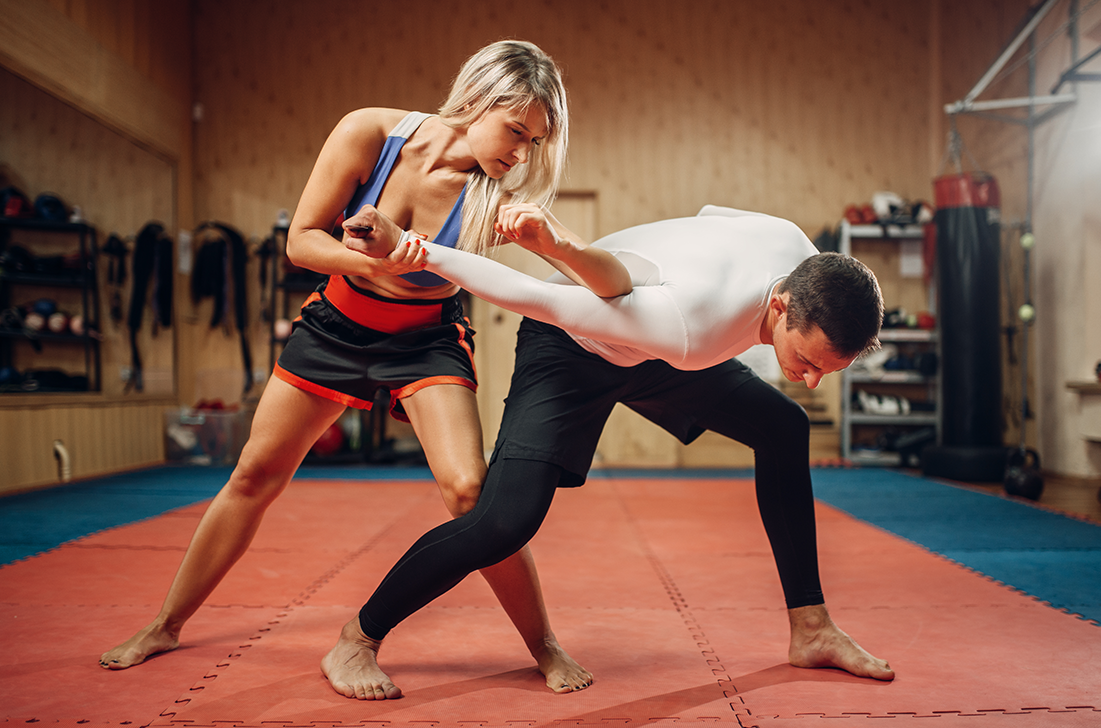
Wrist-grab defenses introduce leverage, positioning, and grip mechanics. Rather than pulling directly against an attacker’s strength, students practice changing the angle of the arm or repositioning the body to create an opening. Some situations require both hands or additional movement. Techniques that work during cooperative demonstrations may fail against determined resistance, making progressive partner drills essential.
Defense Against Chokes and Holds
Beginner programs may introduce defenses against frontal chokes, rear grabs, and other restraints. Pressure on the neck can restrict breathing or blood flow to the brain, potentially causing rapid loss of consciousness and serious injury. Training requires close supervision, controlled contact, and immediate release signals. The objective is to relieve dangerous pressure, recover movement where possible, and reach safety. No release is reliable in every position, especially when an attacker has established strong control.
Defensive Movements and Escapes
Defensive movement combines protective actions with repositioning. Beginners first learn individual responses before practicing them against moving partners. Blocks use the arms or hands to intercept strikes, while parries redirect incoming attacks. Compact movements generally preserve better protection than exaggerated blocks. Head movement can help avoid certain punches, but excessive slipping or ducking may expose the defender to knees or follow-up strikes. Escaping clinches requires balance, grip management, and body positioning.
Common drills include defenses against bear hugs, clothing grabs, and attempts to pull someone off balance. Ground defense is another important component. Students may practice breakfalls, protecting the head, maintaining space with the legs, and returning to their feet. The technical stand-up, also used in grappling disciplines, allows a practitioner to rise while maintaining a protective structure. Its usefulness depends on available space and the attacker’s position.
Strikes and Counterattacks
Counterattacking drills teach students to recognize openings rather than rely on fixed combinations. A defensive movement may lead into a punch, palm strike, elbow, or knee, depending on distance and positioning. Students initially practice short combinations against pads. Later exercises introduce moving partners, changing attack directions, and controlled resistance. The objective is to develop timing and appropriate responses rather than memorize lengthy sequences.
What to Expect During Krav Maga Training
Beginner Krav Maga training generally combines conditioning, technical instruction, partner exercises, and practical scenarios. Many classes last approximately 45 to 90 minutes, although schedules vary. Sessions often begin with cardiovascular warm-ups, mobility exercises, and basic movement drills. Instructors then demonstrate techniques before students practice them on pads or with partners. Conditioning may include push-ups, squats, running intervals, and core exercises. These activities develop general fitness, but excessive fatigue can interfere with technical learning.
How Beginners Should Approach Training
Accuracy matters more than speed during early practice. Controlled repetition helps establish balance and coordination before drills become more demanding. Students should communicate injuries or physical limitations and ask for clarification when movements feel unstable. Partner resistance must increase gradually, with both participants understanding the exercise. Depending on the school, protective equipment may include boxing gloves, shin guards, mouthguards, and groin protection.
Stress Drills and Scenario Training
Scenario exercises introduce distractions and changing conditions into familiar techniques. An instructor might require students to reach a designated exit after defending against an attack delivered at controlled intensity. Another drill could involve maintaining distance from an approaching partner while responding to verbal aggression. Effective scenarios test specific skills and provide feedback. Simply increasing confusion or exhaustion does not necessarily improve defensive ability.
How Often Should Beginners Train?
Two or three classes per week offer a manageable schedule for many adults, allowing consistent practice and recovery. Those unfamiliar with regular exercise may begin with one or two sessions. Fitness level, previous experience, and training intensity should guide further progression. Early improvement is best measured through observable skills: maintaining balance, recognizing common attacks, and performing basic defenses against controlled resistance.
Choosing a Krav Maga School
A suitable school provides structured instruction, qualified supervision, and exercises appropriate for different experience levels. Observing a class can reveal how instructors correct mistakes, manage contact, and introduce resistance. Students should have opportunities to ask questions without being pressured into unsafe drills. Promises of guaranteed protection against armed attackers or rapid mastery of self-defense are warning signs. Real confrontations remain unpredictable regardless of training.
Krav Maga vs Other Martial Arts
Krav Maga incorporates techniques found in several fighting disciplines, but its objectives differ from those of competitive martial arts. Boxing, Muay Thai, Brazilian jiu-jitsu, judo, and mixed martial arts develop skills relevant to personal protection. Their competitive formats also provide regular opportunities to practice against resisting opponents.
| Discipline | Primary focus | Common training methods |
| Krav Maga | Self-defense and threat management | Defensive drills, striking, escapes, scenarios |
| Boxing | Punching and defensive movement | Pad work, bag work, sparring |
| Muay Thai | Stand-up striking and clinch fighting | Punches, kicks, elbows, knees, sparring |
| Brazilian jiu-jitsu | Ground control and submissions | Positional drills and live rolling |
| Judo | Throws and grappling | Throwing drills and randori |
| MMA | Integrated striking and grappling | Technical drills and sparring |
Krav Maga vs MMA
The Krav Maga vs MMA comparison is common because both combine striking and grappling techniques. MMA is a regulated combat sport in which athletes prepare for competition under established rules. Regular sparring against resisting opponents helps develop timing, distance management, and physical control. Krav Maga places greater emphasis on recognizing threats, handling common forms of assault, and escaping dangerous situations. Its curriculum may include verbal intimidation, weapon-related threats, and environmental hazards outside MMA competition.
However, MMA’s emphasis on live resistance can produce stronger fighting fundamentals than Krav Maga programs built primarily around cooperative demonstrations. Neither system guarantees success outside training. MMA develops striking and grappling under resistance, while well-structured Krav Maga instruction adds scenario-based self-defense and threat management.
Krav Maga vs Traditional Martial Arts
Traditional martial arts differ considerably in technique and teaching methods. Karate, taekwondo, and judo, for example, emphasize different combinations of striking, grappling, and competitive practice. Some schools prioritize forms and technical precision, while others introduce sparring early. Many Krav Maga programs incorporate scenarios involving common forms of assault from the beginning. That does not automatically make their techniques more effective. Instruction quality, consistent practice, and realistic resistance remain important across disciplines.
Benefits and Limitations of Krav Maga
Krav Maga offers a broad introduction to personal protection while developing physical conditioning and defensive skills. Its effectiveness depends on instructional quality, consistent practice, and opportunities to apply techniques under controlled pressure.
Potential Benefits
Accessibility is one advantage. Most introductory classes accept students without previous martial arts experience, and exercises can often be adjusted to different fitness levels. Regular training may improve cardiovascular endurance, coordination, balance, and muscular endurance. Results depend on class intensity, consistency, and individual physical condition. Scenario exercises provide opportunities to practice decisions under pressure. However, improvements during training do not guarantee the same performance in real confrontations. Learning to recognize aggressive behavior, maintain distance, and identify escape routes may also improve personal safety without requiring physical force.
Limitations and Risks
Krav Maga’s broad curriculum can restrict the time available for mastering individual techniques. Learning numerous defenses without sufficient repetition may leave students unable to perform them against resistance. Training standards also vary. Some schools incorporate regular sparring and progressive pressure testing, while others rely heavily on choreographed demonstrations. Weapon defenses present substantial risks.
Attempting to disarm someone carrying a knife or firearm is extremely dangerous, even for experienced practitioners. No empty-handed technique guarantees safety against an armed attacker. Physical injuries are another concern. Sprains, strains, bruising, and more serious injuries can occur during poorly controlled contact exercises. Protective equipment, supervision, and gradual progression help reduce these risks. Krav Maga can develop useful defensive skills, but it cannot eliminate the uncertainty of real violence.
FAQ
Is Krav Maga good for beginners?
Yes. Many Krav Maga programs accept students without previous martial arts experience. Introductory classes generally cover stance, footwork, basic strikes, and simple defensive movements. A suitable school introduces contact gradually and emphasizes proper technique.
How long does it take to learn Krav Maga?
Basic movements can be introduced within a few classes, but reliable execution requires considerably more practice. Progress depends on training frequency, instruction quality, physical ability, and experience against resistance. No fixed training period guarantees readiness for every self-defense situation.
Do Krav Maga classes include sparring?
Some schools incorporate regular sparring, while others focus on pad work, partner drills, and simulated attacks. Controlled sparring helps develop timing and distance management, but beginners should establish fundamental skills before progressing to harder contact.
Is Krav Maga better than boxing or MMA for self-defense?
Each offers different advantages. Krav Maga emphasizes threat recognition, defensive scenarios, and escape. Boxing develops punching mechanics and footwork, while MMA combines striking and grappling against resisting opponents. Training quality and practical experience matter more than the discipline’s name.
Can Krav Maga be practiced at home?
Footwork, conditioning, and basic movement drills can be practiced independently. However, defensive techniques require feedback from a qualified instructor and controlled partner practice. Solo exercises cannot reproduce the timing, resistance, or unpredictability of another person.